
![[personal profile]](https://www.dreamwidth.org/img/silk/identity/user.png) bookgazing) wrote2011-04-07 03:10 pm
bookgazing) wrote2011-04-07 03:10 pm


'The Eagle'
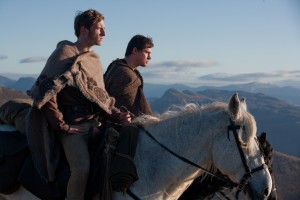
Oh ‘The Eagle’! How can I be so in love with a film and at the same time have some major quibbles with it at the same time? Today I’m going to focus on the positive squishy feelings. I’ll try to get some critical thinking going about the aspects of this film that bother me next week after readathon.
I grant myself permission to be a little bit sappy now. I saw ‘The Eagle’ a couple weekends ago. It made me go awwwww quite a bit in my head, which is strange because it is film that most would call super manly, as it is full of men and violence. So why the awwws from this lady? Am I intent on feminising glorious manly displays of maleness with awwws? Lemme explain why I felt like this film was handing me a big, warm bowl of soup in the midst of all the violence.
‘The Eagle’ is essentially a quest narrative and a buddy movie. Esca, the Brigante slave (played by the now delicious Jamie Bell) and the decorated, but injured Marcus Flavius Aquila (played by the delectable ‘I never thought I’d fancy him quite so much’ Channing Tatum) must ride across inhospitable, unconquered Northern Britain to retrieve an eagle standard. This standard was ripped from Marcus’ father’s legion (the Ninth) during a bloody, battle many years ago in which Marcus’ father died. Marcus sets out to retrieve the standard because despite his exemplary courage in a major battle, now that he is wounded he has no further opportunity to wipe out what others see as his father’s failure. Marcus saves Esca’s his life in an arena fight. Marcus’ uncle buys Esca as a slave for his nephew and although Marcus tells Esca he can run without anyone stopping him, Esca still feels he owes a bond of debt to the Roman whose values he despises.
A few things about this film touched me deep in my heart.
First, the realisation of Marcus’ struggle to restore his family’s honour is given a lot of space and is the driving force of the whole film. Unlike some films that focus around quests and battles ‘The Eagle’ doesn’t just state the motivation for its main character’s actions at the start of the film, consider the emotional side of the story dealt with and move on to a quest filled with battle sequence after battle sequence. Instead it often reiterates Marcus’ relationship with his father and family honour. It reminds the watcher of the importance of father son relationships in general by having Esca talk about his own dead father. By often returning to the emotional motivations behind the quest ‘The Eagle’ encourages the viewer to remain focused on the characters, allowing them to develop deeper connections with them than perhaps their acting performances would encourage (I loved watching Channing Tatum, but I think his pretty probably keeps me from paying attention to the flaws other reviewers have noticed in his performance – I am kind of shallow like that when it comes to visual media).
I have a soft spot for films that deal with family relationships, whether the family is present on the screen or not, but I do think ‘The Eagle’ handles this theme with tenderness. The flashbacks to Marcus’ blurry memories of his father handing him a wooden eagle are effective in connecting the viewer with a real relationship he had with a now dead character. A scene where Marcus goes to join the Ninth and spends time in front of his family tablet, performing rituals to the gods in the hope that they will help him to restore his family honour is simple but touching. And the first time I really thought hard about the way that Roman’s glorious expansion was based on the destruction of Britain’s tribes came when Esca talked about his royal father being killed by Romans. This theme was really well presented and utilised to make me care about the quest plot that pushes the film forward.
The next element that made me melt just a little was Esca and Marcus’ on screen partnership. Quite a few reviewers are casually calling ‘The Eagle’ a bromance film, which implies that it is a bit silly and overly touchy feely (at least that’s the vibe I get when people use the term). I will toss in my two pennies and say if someone wasn’t deliberately subverting masculine norms of closeness in this film’s production I would be very surprised. Near the beginning of the film Esca has to hold Marcus to a table during surgery and there is a moment of very intense eye connection that would not have looked out of place in a film like Twilight (which is, as I think cleolinda said much more elegantly, all about the eye sex). One line from the film that passes between Tatum and Bell – ‘I thought I had lost you’. There is a scene where Esca puts his hand on Marcus’ face while they are parting, because Marcus is injured and Esca is being made to leave. This scene takes place underneath a waterfall, the fantasy romantic setting of the millenium. The emotion in that gesture goes well beyond traditional representations of male friends who part, knowing that one of them may soon be dead.
All these moments of connection could alternatively be viewed as an attempt to inject some much needed emotional realism into the portrayal of male friendships, that have been formed during extreme circumstances. Come on, you almost die around someone a couple of times, you kill together, your relationship is going to be full of powerful emotion. Why must any sense of deep feeling towards male friends be glossed over by so many films about male comradeship? We need films to present a range of ways it might feel to be in situations that could be fatal with your male friends, rather than constantly pushing this ‘stoic and nerved up’ version. That’s one way it might feel, it’s not the only way. Ends soapbox moment. I’m not fussed about asserting that one of these interpretations is FACT. I like both interpretations very much. I’m just really glad these scenes are in ‘The Eagle’, because they provide a level of male connection we don’t very often see on screen.
Actually I think the film does a great job overall, of subtly exploring concepts that are traditionally linked with how masculine a man is, such as honour, strength and mastery of the self. One of my favourite aspects of this film is that it achieves this exploration without tipping characters the audience is supposed to validate, like Marcus, into an obsessive state where they try to prove how masculine they are while the audience continues validates their erratic behaviour. Marcus wants to regain his family’s honour and his quest to do so seems unnecessarily foolhardy, but Marcus doesn’t generally appears unhealthily driven by the need to regain honour (and by proxy masculinity). His quest is founded not in desperation for himself and his image, but in true belief that his father does not deserve to be remembered so badly. He wants to prove himself and by extension prove his whole family’s honour deserves to be restored, but he doesn’t need to do so because he feels something is lacking in him and his family, more because he wants people to recognise what is really, already great about him and his family. Does that make sense? Maybe I’ve talked myself in circles there.
When Marcus does appear to transverse the boundaries of reasonable behaviour in his drive to complete his quest the film depicts his actions as rough, or angry, not as positive actions that are justified because of his cause. He holds a knife to a man’s throat to gain information, he kills a child Esca had let live and that he mistrusts Esca (wh will later save his life) on this quest, but all this behaviour is ‘punished’ when Marcus’ is forced to be a slave himself. The way I read his eventual redemptive recapture of the eagle is that Marcus earns his reward by understanding a life of oppression, bonding with his slave as an equal and allowing Esca to convince him that he shouldn’t kill another British child. I’m not sure that this idealistic approach to ideas about the reversal of oppression is very through, but I do like that his bad behaviour on this quest results in consequences and censure, rather than defensive justification.
Finally, I’ll have a bit of a nationalistic moment and say how much I bloody love British cinema right now, especially Film 4 projects. The dulled natural palette that ‘The Eagle’ features helps to create the right vaguely threatening atmosphere for this film and the composition of the shots make beautiful use of ideas about space. Never change sort of arty, but still commercial British cinema. Never change.
