
bookgazing (![[personal profile]](https://www.dreamwidth.org/img/silk/identity/user.png) bookgazing) wrote2011-06-23 05:33 am
bookgazing) wrote2011-06-23 05:33 am
bookgazing) wrote2011-06-23 05:33 am


Entry tags:
'The World More Full of Weeping' - Robert J Wiersema (Close Title Reading)
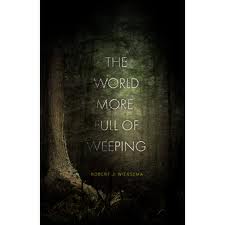 ‘The Reading Ape’ recently spent a post looking at the first line of Margaret Atwood’s ‘The Blind Assassin’ which made me remember how enriching close reading can be. As one commenter said the brain does a lot of close reading unconsciously, but it’s fascinating to slow down and identify just what the brain is seeing and processing in a flash. I’m going to try my hand at something a little different today. I’ve decided to have a go at some close reading, but I’m going to take a look at what is going on in a title, instead of the first sentence. Bare with, this is a bit experimental for me.
 'The World More Full of Weeping’ – Robert J Wiersema
‘The World More Full of Weeping’ is a title of some grand strangeness.
First the phrase ‘More Full of’ strikes me as an unusual construction. The graded quantifier ‘More’ sits before the adjective ‘Full’* in a way that sounds undeniably odd. Would you ever say ‘More Full’? It sounds strange doesn’t it, possibly even like incorrect grammar** ?
I almost think it sounds old fashioned, like a turn of phrase that is uncommonly seen (it’s probably more common to say fuller, although that would sit very clumsily in this phrase – imagine ‘The World Fuller of Weeping’). There’s no verb ‘is’ in between ‘World’ and ‘More’, which again I read as an old fashioned form of phrasing (I’m not really sure why though, I just feel like a sentence without all the verbs sounds like an older form of English). The old fashioned feeling is added to by the use of ‘Weeping’, a grand word of high feeling that isn’t used much in common, modern speech. Mourners weep at the funerals of great heroines in epic tragedies. I might be projecting on to this title, because I know what’s contained in the novel, but perhaps it’s possible to feel historical resonance in the wording of this phrase, which might be surprising as the blurb doesn’t suggest that this novel contains a historical storyline.
And that phrase construction, which feels old fashioned to me, gives the title gravitas. Add in the use of the word ‘Weeping’ and I’m feeling associations with weighty moments of sadness, or performative sadness at occasions of great importance. This novella feels like it will be concerned with important events, but the sense of maybe even formality suggests that the seriousness of these events may go beyond ordinary human tragedy.
Weeping is a very vocal, obvious display of sadness, that happens when terrible events like the death of a loved one take place. You don’t generally weep, or describe yourself as weeping because you’ve dropped the milk (although you might if that was the last straw in a series of terrible events). And it’s the ‘World’ that is full of this weeping, not just a world, which implies a personal tragedy, but the world. Either the events in this book affect the whole world, or they’re so tragic that it at least feels like the whole world is full of weeping to those involved. It’s a tragedy with a grander scale of feeling. So, we know this book is likely going to be about a truly awful tragedy. No reader is going to open this novella expecting happy endings and they might also experience levels of trepidation about how much tragic the narrative is going to be.
The fact that ‘Full’ is being measured, instead of rendered simply as a complete state, encourages me to ask questions about how full the world was of weeping initially. As the title opens the door for me to question, I suddenly notice that there are other things I want to know. Why the world is full of weeping. Weeping over what? What has happened here? That’s the hook to draw me in to the story.
Do you respond to the title the same way I do? What else would you pull out of this title?
* Yes I did have to go off and peruse grammar sites to get there, I suck at grammar construction and I may still be wrong about that adjective, but I thought I’d give this a go
** It isn’t but it would have butted up against the general rule teachers gave out at schools I went to, that we should see if phrases ‘sounded right’ and if they didn’t they probably weren’t grammatically correct
Edited: In the comments AbbotofUnreason suggested that the title sounded like it had come from a poem and a quick search shows it is a phrase from 'The Stolen Child' by William Yeats, which considering what goes on in the novel is very appropriate. Does close reading of a title work if it's a line from somebody else? No idea.
