
bookgazing (![[personal profile]](https://www.dreamwidth.org/img/silk/identity/user.png) bookgazing) wrote2011-10-02 12:30 am
bookgazing) wrote2011-10-02 12:30 am
bookgazing) wrote2011-10-02 12:30 am


Entry tags:
'The Vesuvius Club' - Mark Gatiss
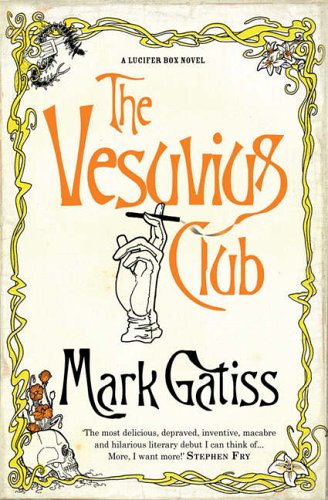 It’s no surprise to me that Gatiss, who worked on the recent reboots of two beloved sources of British entertainment (‘Dr Who’ and ‘Sherlock’), has playfully plaited elements of classic crime novels and British male heroes into his novel. Lucifer Box, the protagonist of ‘The Vesuvius Club’, is a distinct character from classic British crime stopping heroes like Bond and Holmes, as his story is set in the Edwardian era, he’s a bit dandyish and he keeps his work secret from those around him. Still, his character betrays strong links to these classic heroes.
As Lucifer Box the most scandalous and the eligible bachelor in Edwardian society he paints (the equivalent of Holmes cultured love of the violin). He has little patience of empathy for those around him (Holmes). He always knows where to find a quiet spot for the uninterrupted satisfaction of any willing lady (Bond, of course).
As Lucifer Box, agent for The British Secret Service, Box is efficient with a pistol (Bond) and has an almost sociopath enthusiasm for the ruthless pursuit of wrongdoers (Holmes). These features of his character make him a fantastic asset for the crown, even if his incautious nature has led to some problems in the past (Holmes, Bond, every secret agent ever).
It’s not just Box’s personality that is reminiscent of classic British novels about solving crimes and serving your country. ‘The Vesuvius Club’ also contains little textual flourishes that allude to the Bond and Holmes narratives. The names of the characters are sometimes deliciously over the top. If you thought the suggestive names of ‘Holmes’ villains like Lord Blackwood and Lord Coward were a bit over the top even for a pastiche, grab something and squeeze hard. Box meets people called Cretaceous Unmann and Charlie Jackpot, whose names become extremely suggestive after the reader learns a little about the characters. This kind of comic naming can be tiring, if not embarrassing, in pastiche novels, or even in classic sources. Fleming’s tendency to name his female characters suggestively is best ignored, for instance, but the game of names in ‘The Vesuvius Club’ remains fresh because the joke that is presented to the reader is constantly varied. Some characters are named suggestively, while some names present mild intellectual games that ask the reader to ferret out the connection to a cultural reference. One man is called Professor Verdigris...a posher version of Professor Green from Cludeo maybe? A Mrs Midsomer Knight appears. For variation, some characters have perfectly ordinary names, like Tom Bowler and Delilah, that don’t gesture to a part of their character or an in joke.
So, like many contemporary novels with historical settings ‘The Vesuvius Club’ includes a certain amount of pastiche, which forges connections between the novel and the literary traditions established by older sources. The fondly mocking attempt at imitation engages the reader in the fun of recognising what is being mimicked by the naming conventions and the chapter titles like ‘The Man in the Indigo Spectacles’. The witty voice of Box sounds a bit like Wilde, or The Scarlet Pimpernel, which again creates more narrative connections for the reader to delight in. Even the fast, fun adventure narrative which poses no real threat to Box’s safety (although the reader may feel he is in danger while in the thick of the action) is a kind of reproduction of earlier entertainment styles like Bond narratives and musketeer movies. No hero dies today. The connection between these particular areas and the familiar novelistic conventions of other exciting sources provides a certain element of cosy fun; aha moments of recognition are available to all kinds of readers.
Unfortunately ‘The Vesuvius Club’ extends its reflection of narrative tradition into a reproduction of old, representational stereotypes. As part of his search to unravel the novel’s central mystery Box meets a Chinese man; a Chinese man called Mr Lee who reportedly runs an opium den. Mr Lee speaks to Box in incomplete English phrases like ‘ ‘Why you come like this? We all friends here. You want pipe?’ ’. I’m sure that given his stereotypical name Mr Lee could be considered just part of the pastiche element of this novel, but to me it seems that his character has been plucked right out of the chest marked ‘lazy historical stereotypes’. His characterisation can’t even be explained by the usual cry of ‘contextually realistic views’ because the narrative doesn’t just make Box bark out his own prejudiced views, it actually makes Lee really represent the stereotype.
It gets...not worse, just differently stereotypical. Mr Lee is actually not the rather stupid, weak man he appears to be. He is cunningly disguising himself, until an opportunity to overpower Box appears. Aha, aha I thought, subversion is coming surely. He will turn out to be a criminal mastermind! Lee indeed reveals himself to be a violent, much stronger criminal, but he also turns out to be a villain who is involved in drugging people and carting their bodies away. In this second Mr Lee, there’s a manifestation of a historical white Western fear that Chinese people would drug white women and sell them into slavery. He may, or may not still be the owner of an opium den, as it isn’t clarified whether this was a pose as part of his disguise, so we get the narrative possibility that Mr Lee continues to conform to that pervasive, unjustified stereotype of the seedy Chinese opium seller.
This easy acceptance of racial stereotypes is disappointing, because ‘The Vesuvius Club’ spends time subverting other areas of the dominant cultural narrative. It is totally #teamboyskissing. A ‘secret’ that prevents Box from breaking ties with his British Secret Service employer Joshua Reynolds; yes that Joshua Reynolds is hinted at early on. If, like me, you were told that Box is a gay spy you will be confused by the fact that Lucifer’s secret does not seem to be his sexuality, as he makes eyes at a lady called Bella Pok for a significant portion of the book. Then, bam, there we go, a character called Charlie Jackpot arrives and Lucifer’s secret is revealed; he’s bisexual. The few sentences of social commentary that follow this revelation make it clear that the narrative has been designed to deliberately conceal the protagonist’s sexuality, so that later a surprise can be sprung.
‘You are shocked are you not? Or perhaps reading this in some distant and unimaginably utopian future like that funny little man Mr Wells would have us believe in, you are not shocked at all!’
‘The Vesuvius Club’ intends to confront reader expectations about what kind of men can be secret agents. The protagonist is a bisexual male spy. He is both an incredibly fastidious dresser and a violent sociopath who will happily shoot someone in the head (a ruthlessness which is framed as a good quality, as it is in many secret agent narratives). He swirls stereotypical expectations around and makes popularly perceived norms about gender and sexuality all messy.
At the same time the novel thoughtlessly embraces certain racial stereotypes in the way it presents Mr Lee. And late on a strange approach to transgender people shows up, tottering down the line between ‘contextually relevant opinions, which are frowned upon in modern liberal society’ and ‘modern casual privilege’. There are places where the novel contributes something new to the mainstream narrative (its villain is a transgender mad scientist, which is not exactly a common character type), but these new elements are limited in the way they subvert narrative common places. Putting a transgender scientist villain into a novel confronts reader expectation that an action adventure narrative must always be a straight, male affair. However, if the narrative allows its protagonist to (however contextually relevantly) dismiss a transgender character’s choice, it is still allowing that certain areas of the negative dominant cultural narrative do not need to be destabilized.
It’s a shame that ‘The Vesuvius Club’ contains this negative cultural reinforcement, because it’s also a full on fun, frantic, inventive novel, which features energetic coach chases through cemeteries, sci-fi style volcano bombs, sudden shootings and visits to decadent brothels. A sexy, sometimes tender new relationship springs up between Lucifer and Charlie, resulting in moments like this:
‘ “This is meant to be my day off,” said Charlie. “Who do I talk to about overtime?”
I looked him directly in the eye and managed a smile. “Charlie, what can I say?”
He stroked my hair with uncommon gentleness. “All part of the service.” '
despite Lucifer’s best efforts to keep Charlie a detached fuck buddy. The fact that Gatiss has built a novel around a bisexual spy protagonist is marvellous. However, the problem of the novels reliance on stereotypes remains. ‘The Vesuvius Club’ is the novel with a self centred, crime solving, bisexual spy making out with a friendly, sexy, kickass gay male side kick. It is also the novel where a transsexual character is insulted by Box for being transsexual and has no space to reply to that (oh and of course that character dies, along with Mr Lee). As Sarah Rees Brennan says in her excellent essay ‘All Those Who Default From the Default Will Be Punished (But Personally I think They Will be Awesome)’, ‘it’s much easier to criticise something that’s present than to criticise the absence of something’. It’s important to remember when critiquing novels which subvert some cultural norms, but still display their own set of cultural problems, that there are billions of books out there which avoid such cultural criticism because they conform so fully to prevailing narratives. Still, it’s hard not to be disappointed at the limitations of this particular novel.
